The first AI election: $137 million in AI-made ads, and the AI money behind the races
Oct. 28, 2026 · AI news · About a 5-minute read
If a political ad has made you squint at your TV this fall and think "wait, did they really say that?", you're not imagining things. The 2026 midterms are the first U.S. election where AI is everywhere: in the ads, in the money, and on the ballot as an issue. Here's what's real, who's doing it, and what the rules are, which right now isn't much.
The ads: from almost nothing to $137 million
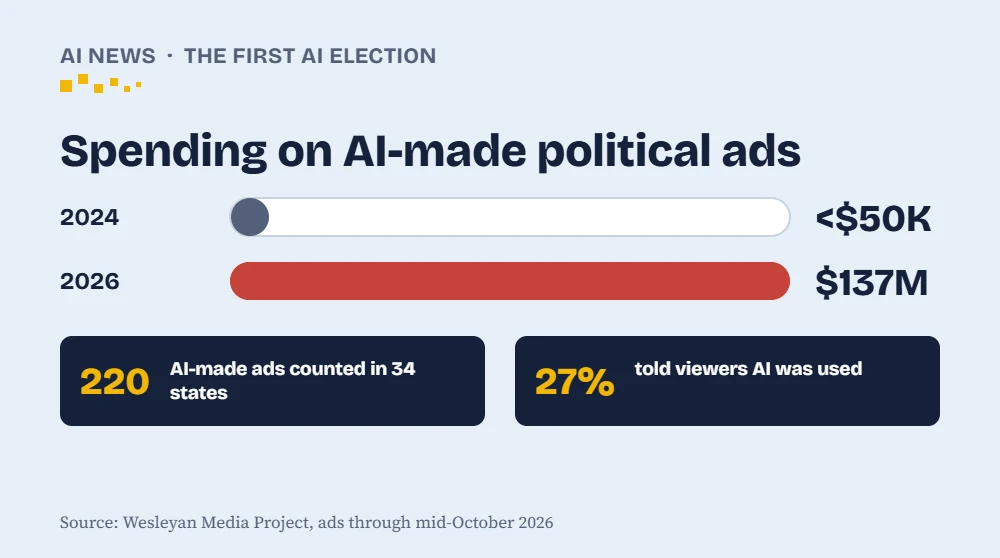
The nonpartisan Wesleyan Media Project, which tracks political advertising, has counted 220 ads made at least partly with AI, with more than $137 million behind them, across 34 states, as of mid-October. The researchers say that's almost certainly an undercount.
For comparison, they found less than $50,000 in AI ad spending for the entire 2024 cycle.
A few more numbers from their count:
- Only 27% of the AI ads told viewers AI was used.
- Nearly half are deepfakes of real politicians, often putting a local candidate next to a national figure from the other party.
- Republicans and Republican-aligned groups sponsored about 81% of the AI ads and 88% of the spending. Democrats sponsored about 12%, and independents the rest.
What these ads look like
Some are obvious jokes. Some are not.
- Michigan Senate: A PAC aligned with Sen. Ted Cruz ran an ad showing Democrat Abdul El-Sayed holding made-up signs reading "Death to America" and "Celebrate 9/11." It did carry an AI disclaimer.
- Georgia Senate: The Senate Leadership Fund ran an AI ad showing Democratic Sen. Jon Ossoff at a salon, with no AI label. Ossoff demanded it be taken down.
- Texas Senate: The National Republican Senatorial Committee released a video of Democrat James Talarico appearing to read old posts out loud and say things he never said. Talarico has since run his own ad that ends "Made by humans. Not AI."
- New York governor: Republican Bruce Blakeman has posted at least 22 AI ads, including ones showing Gov. Kathy Hochul and New York City Mayor Zohran Mamdani in scenes that never happened. His campaign calls them satire. The state Democratic Party filed a complaint.
- It cuts inside parties, too. Kentucky Republican Rep. Thomas Massie was hit by AI ads in his primary, including one showing him at dinner with Democratic Reps. Ilhan Omar and Alexandria Ocasio-Cortez. He says they helped cost him the race.
- And Democrats have stumbled. In San Francisco, Democrat Scott Wiener's congressional campaign put out an AI chatbot that mocked his opponent's accent and record. After criticism that it was bigoted, Wiener pulled it, saying it "missed the mark."
Researchers have a name for the jokey kind: "slopaganda." These are ads that look fake on purpose and claim to show a "deeper truth" rather than a real event. The worry, says NYU's Scott Babwah Brennen, is what that does to voters' trust in everything they see.
The rules: a patchwork
- There's no federal law requiring political ads to disclose AI. A disclosure bill has been introduced in the House but hasn't passed.
- More than 30 states have their own election deepfake laws, according to Public Citizen's tracker. Some require a label, some ban misleading deepfakes close to an election, and the details vary a lot.
- Labels don't always show up. One analysis of the Wesleyan data found about 29% of AI ads were labeled in states with laws, and about 32% in states without them. So far the laws don't seem to have changed much.
- Both sides of the debate have a point. Public Citizen's Ilana Beller says state laws respect free speech limits but "there is still a need for a federal law." Others, like Adam Rose of Starling Lab, argue AI ads shouldn't be banned, and voters can judge candidates by how they use them. The political consultants' trade group wants one national standard instead of 50.
I live in Texas, which was the first state to act, back in 2019. Texas law makes it a crime to create and publish a deepfake video within 30 days of an election to hurt a candidate or sway the result.
The money: AI companies are playing, too
AI isn't just in the ads. AI money is behind some of the races.
- Leading the Future is a super PAC network that wants one national AI standard and opposes separate state rules. Its backers include OpenAI president Greg Brockman and his wife Anna, and venture capitalists Marc Andreessen and Ben Horowitz. It had raised close to $76 million by the end of June. It runs a Democratic arm called Think Big and a Republican arm called American Mission.
- Public First is a network pushing for stronger AI safeguards. Anthropic has given it $40 million and says the money is limited to public education and policy work, not candidate elections. An allied super PAC, Jobs and Democracy PAC, spent heavily on its own.
- Innovation Council Action is a newer pro-AI group led by Republican strategist Taylor Budowich and championed by White House AI adviser David Sacks. It plans to spend more than $100 million backing candidates who line up with Trump's lighter-touch AI agenda, and it keeps a scorecard on lawmakers.
- Meta is backing its own super PAC, expected to spend about $65 million on state races.
By late July, Business Insider had counted more than $65 million in disclosed AI-aligned political spending, and the total has kept climbing.
The clearest head-to-head came in New York's 12th District Democratic primary. Alex Bores, a state lawmaker who wrote AI safety rules, was the target. Think Big spent about $8 million against him, and Jobs and Democracy PAC spent more than $15 million for him. Bores finished second.
Here's the strange part, reported by NBC News: many of these AI-funded ads barely mention AI. Think Big's attacks on Bores were about his old employer's work for immigration enforcement, not AI policy. The money is about AI. The ads are about whatever moves voters.
My take
Two things can be true at once. AI can make a funny campaign meme. And a realistic fake of a candidate saying something terrible, with no label, can fool people a week before they vote.
Remember the poll in my last story: 57% of Americans already think AI is bad for society, and the most common fear is losing the ability to tell what's real. Ads like these feed exactly that fear, no matter which party runs them. Whoever you vote for, do yourself a favor: before you believe or share a clip that makes your blood boil, take 30 seconds to check it. I put together a quick guide for that.
Disclosure, and it's a big one: I use AI tools, including Claude, to help research and write. Claude is made by Anthropic, which funds Public First, one of the groups in this story. OpenAI's president funds Leading the Future, and OpenAI makes a competing AI. I've tried to describe both sides the same way, and this story doesn't endorse any candidate, party or PAC.
Sources:
- Gizmodo: $137 million and only 27% disclosed (Wesleyan Media Project)
- IBTimes: party breakdown and examples
- Al Jazeera: deepfake ads blur the truth
- WJLA: Massie, Mamdani and Blackburn ads
- Public Citizen: state deepfake law tracker
- NBC News: AI-funded ads that aren't about AI
- Let's Data Science: $65M+ in AI-aligned spending
- Fox News: Innovation Council Action's $100M plan
More to read
- From MKUltra to AI: the long history of messing with your mind
- Forced to pick, two big AIs split along party lines
- Real race, fake videos: AI ads take over the Texas Senate fight
- What Trump is actually doing about AI, and what Americans think of it
- How to spot an AI political ad before you vote (or share it)