What Trump is actually doing about AI, and what Americans think of it
Oct. 27, 2026 · AI news · About a 6-minute read
Few people are neutral about Donald Trump. AI is starting to look the same way. So I skipped the hot takes and went to the source: the executive orders, fact sheets and plans the White House has published, plus the newest national polling on how Americans feel about AI. Here's what's on paper, what supporters and critics say about it, and where the public stands, one week before the midterms.
The short version
Trump's AI policy comes down to one idea: win the race with China, and don't let regulation slow America down. He's said it plainly: "Whoever wins AI wins." To get there, his administration has cut rules, pushed to build data centers and power plants fast, tried to stop states from writing their own AI laws, and leaned on voluntary promises from tech companies instead of new federal rules.
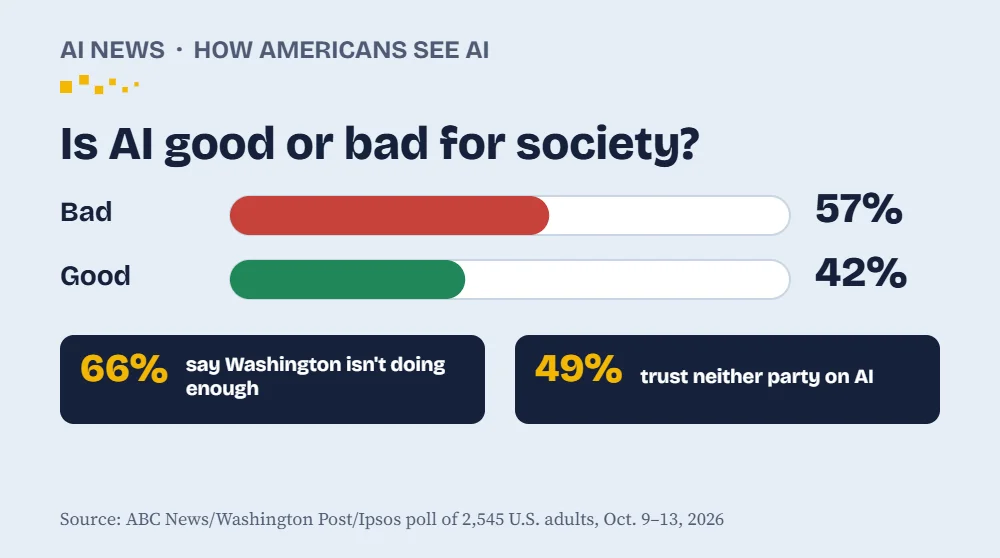
The public is more nervous. In a new ABC News/Washington Post/Ipsos poll, 57% of Americans say AI is bad for society, and two-thirds say the government isn't doing enough to regulate it. That worry crosses party lines.
What's actually on paper
Here are the main moves, in order, straight from the White House documents.
- January 2025: Out with the old rules. On his first day back, Trump revoked President Biden's 2023 AI executive order. Three days later he signed his own, titled "Removing Barriers to American Leadership in Artificial Intelligence."
- July 2025: The AI Action Plan. "Winning the Race: America's AI Action Plan" lists more than 90 federal actions under three pillars: speed up AI innovation, build American AI infrastructure, and lead on AI diplomacy and security. It tells agencies to find and repeal rules that slow AI down, speeds up permits for data centers, backs open-source AI, and says federal funding decisions can weigh a state's AI "regulatory climate." Three executive orders came with it: one on data center permits, one on exporting American AI to allies, and one titled "Preventing Woke AI in the Federal Government," which says the government should only buy AI models it considers free of "ideological bias."
- December 2025: Taking on state AI laws. An executive order titled "Ensuring a National Policy Framework for Artificial Intelligence" set up a Justice Department task force to challenge state AI laws in court. It also directs the Commerce Department to list state laws that clash with national policy, and it ties some federal broadband money to states not having those laws. The White House pointed to more than 1,000 AI bills in state legislatures. Trump's words: "We MUST have one Federal Standard instead of a patchwork of 50 State Regulatory Regimes."
- March 2026: A plan for Congress, and a power pledge. The White House sent Congress a legislative framework asking it to override state AI laws it sees as too burdensome. It would leave states their say over their own government's use of AI and over infrastructure, and it covers child safety, power costs, copyright and free speech. The same month, Google, Microsoft, Meta, Oracle, xAI, OpenAI and Amazon signed a "ratepayer protection" pledge to build or buy their own power for data centers, so families don't foot the bill. Congress hasn't passed a federal AI law, so state laws are still on the books.
- June 2026: AI and cybersecurity. An order titled "Promoting Advanced Artificial Intelligence Innovation and Security" pushes AI-powered cyber defense out to agencies and to places like rural hospitals and local utilities. It sets up voluntary early government access to the most powerful AI models for security testing, and it says outright that it creates no "mandatory governmental licensing" for AI models.
- September 2026: "Super intelligence" and an industry pact. After several AI company leaders, including Elon Musk, Sam Altman and Anthropic's Dario Amodei, warned about the risks of moving too fast, Trump said he'd keep the pedal down. Weeks later he signed an order telling federal agencies to stop saying "artificial intelligence" and use "super intelligence," or "SI," instead. The same week, Meta, Nvidia, xAI, OpenAI, Google and Anthropic signed a voluntary White House accord promising internal safety controls, outside audits and independent board reviews. Trump called it "morally binding." It has no enforcement or penalties.
- October 2026: A task force. Trump announced a "Super Intelligence Force" led by Director of National Intelligence Jay Clayton, FTC Chairman Andrew Ferguson, the Pentagon's research chief Emil Michael and federal personnel chief Scott Kupor. It's looking at whether existing laws can hold AI companies responsible when things go wrong. The White House has given few details so far.
The case supporters make
- The China race is real. Supporters say whoever leads in AI will lead the economy and the military, and red tape hands China an opening. Clayton put it this way: "The risk of not being first is high."
- One rulebook beats 50. A startup shouldn't need 50 sets of lawyers to launch a product. Supporters say one national standard protects small companies, not just big ones.
- Use the laws we have. Instead of a new AI agency, the administration says it'll enforce existing fraud, consumer protection and computer crime laws hard, and the FTC has opened an investigation into several AI companies.
- Build, build, build. The power industry's trade group praised the ratepayer pledge, and supporters say faster permits mean more jobs and more power plants.
- Even the name has defenders. Neil Chilson of the Abundance Institute pointed out that John McCarthy, the scientist who coined "artificial intelligence," later regretted the term.
The case critics make
- Promises aren't rules. Critics say voluntary pledges and "morally binding" accords can't be enforced. Energy experts said the same of the power pledge, since electricity is mostly regulated by the states. Even some of the companies that signed the accord want more: Amodei has called for "more serious and binding regulation," and OpenAI said industry standards should complement, "not replace," mandatory safeguards.
- States are where the protections are. This one isn't just Democrats. In July 2025 the Senate voted 99–1 to strip a ban on state AI laws out of a budget bill. Republicans including Sen. Marsha Blackburn, Sen. Josh Hawley and Florida Gov. Ron DeSantis have pushed back on overriding the states, especially where kids' safety is involved. Hundreds of state lawmakers and 26 state attorneys general have urged Congress not to wipe out state AI laws.
- Speed over safety. Critics say pressing ahead while the industry's own leaders call for caution is a gamble. In Congress, Sens. Chris Coons (D), Brian Schatz (D), Katie Britt (R) and James Lankford (R) have a bipartisan bill to make AI companies disclose their safety measures. Sen. Bernie Sanders and Rep. Greg Casar want to ban superintelligence development altogether.
- The renaming. California Gov. Gavin Newsom mocked the "super intelligence" order by declaring "artificial intelligence" California's official term.
What Americans actually think
The ABC News/Washington Post/Ipsos poll surveyed 2,545 adults on Oct. 9–13. Here's what stood out:
- 57% say AI is bad for society, and 42% say it's good. Only 2% say "extremely good."
- Young people are the most worried. 65% of adults under 30 say AI is bad for society.
- Top fears: AI hacking secure systems (73%), wiping out jobs (65%), and people losing the ability to make decisions without it (62%).
- Only 13% think AI will create a lot of new jobs.
- 66% oppose new data centers, and 72% don't want one in their own community, including 58% of Republicans.
- 66% say the federal government isn't doing enough to regulate AI. That includes 80% of Democrats, 66% of independents and 54% of Republicans.
- 30% approve of how Trump is handling AI, and about two-thirds disapprove. Among MAGA Republicans, 80% approve.
- Neither party wins on trust. 26% trust Democrats more on AI, 19% trust Republicans, and 49% trust neither.
A separate Quinnipiac poll found nearly 8 in 10 voters would rather put safety first than race to dominate AI.
My take
Strip out the politics and here's what I see. On the big goal, keeping America ahead in AI, most people on both sides agree. Where they split is how: one national rulebook versus 50 state ones, and voluntary promises versus real rules.
The administration is betting that speed and self-policing win the race. The public, at least for now, is saying "slow down and show me the guardrails." The most telling number in that poll isn't the 30% approval. It's the 49% who trust neither party on AI. That's a lot of people waiting for somebody to earn it.
Whatever you think of Trump, the documents are public, and they're worth reading for yourself. I've linked them all below.
I use AI tools, including Claude, to help research and draft. One disclosure on this one: Anthropic, the company that makes Claude, signed the White House accord, and its CEO is quoted above. This story doesn't take a side on any candidate or party.
Sources:
- Wikipedia: Executive Order 14179
- White House: Ensuring a National Policy Framework for AI (fact sheet)
- White House: Promoting Advanced AI Innovation and Security (fact sheet)
- White House: Inaugurating the Era of Super Intelligence (fact sheet)
- Holland & Knight: what's in the AI Action Plan
- Morgan Lewis: the March 2026 legislative framework
- Baker Botts: recent developments
- ABC News: the poll
- Washington Post: Trump's AI approval
- ABC News: the Super Intelligence Force
- Al Jazeera: how the AI accord works
- Genetic Literacy Project: Trump rejects calls to slow down
- OPB/AP: the ratepayer pledge
- The National: Newsom, Chilson and Quinnipiac
- Implicator: the Republican pushback
- Regulatory Oversight: 26 state AGs