Black Friday is three weeks away. Here's how to spot a fake online store before you pay.
Nov. 6, 2026 · The Working Bits
Last week I showed you how to check a scam email with AI. This week it's the other half of holiday scams: the store itself. Black Friday is Nov. 27, and the fake shops are already open. One security company says its users report a new fake store about every three minutes.1 They're built with AI, they look professional, and a lot of them find you through an ad on Facebook. The good news is that a fake store is usually easy to catch if you take five minutes before you pay. Here's how I do it.
What's actually going on
- Online shopping scams are one of the riskiest scams out there. In the Better Business Bureau's 2025 report, online purchase scams made up 28.4% of all scams reported to its Scam Tracker. Nearly 9 out of 10 people who reported one lost money, and they ranked No. 3 on the BBB's list of riskiest scams.3
- A lot of them start on social media. The FTC says Americans lost $2.1 billion to scams that started on social media in 2025, and $794 million of that started on Facebook. About 40% of the people who reported those scams said they ordered something they saw in an ad.4
- AI made it worse. Savi Security, the company behind the Scamwise checker, looked at more than a million reports this year. It found that scammers now fake the whole store, not just one product. Most fake stores use AI-made photos and text, nearly 40% are less than 90 days old when someone reports them, and 85% are gone within two weeks.12 That's the trick: by the time anyone leaves a bad review, the store has disappeared and a new one has taken its place.
Safety first
Never pay a store you don't know with a debit card, Zelle, Cash App, a wire transfer, crypto or gift cards. If the deal goes bad, that money is usually gone. A credit card gives you the best shot at getting it back.
A real example from my feed
This week this showed up on my Facebook: a short video of a white gadget getting wiped off, with the caption "The perfect gift for a cyclist doesn't exist." The post said "Comment 'Ride' to get yours." The page was one I'd never heard of.
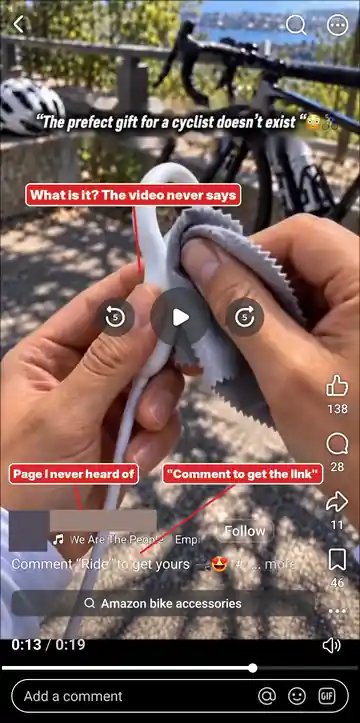
I'm not saying that one is a scam. I couldn't find anything about the page either way. But it has the setup to watch out for: an unknown seller, a product the video never really explains, and "comment to get the link," which gets the post shown to more people and sends you a link in your messages. That's exactly when you run the checks below before you buy anything.
Even on big-name sites, check the brand
Fake stores aren't the only thing to watch for. Big, trusted shopping sites are a much safer bet, since you get their return policies and buyer protection. But they also carry thousands of sellers, and some brands are brand new with almost no track record.
Before you buy, look for a brand you can actually look up, lots of reviews over a long time, and specs that make sense for the price. A gadget that promises a camera, an AI assistant and live translation for a bargain price, with only a couple of reviews, deserves a second look.
The 6 checks
- Don't buy through the ad. Search the store yourself.Close the ad, then type the store's name into Google with the word "reviews" or "scam." If a real store has been around for a while, people will be talking about it. If you find nothing at all, or only the store's own pages, treat that as a warning.
- Check how old the website is.Real stores have usually been around for years. Fake ones are often only weeks old. Look up the web address on a free domain lookup site like who.is or lookup.icann.org, or ask Claude to check it for you (step 5). A store that's only a couple of months old and has huge holiday sales deserves a hard look.
- Look at the address bar and the "About" page.Look for odd spellings of real brand names, extra words, or weird endings like .shop or .top. A "myshopify.com" address isn't proof of a scam, since lots of small real businesses use Shopify, but it was the most common address in Savi's confirmed scam cases.1 Then look for a real phone number, a real street address and a return policy that makes sense. If the only way to reach them is a contact form, or the "About us" page says nothing specific, be careful.
- Compare the price.Look up the same item on Amazon, Walmart or the brand's own website. If this store is selling it for half price or less, there's a reason, and it's usually not a good one. Savi found "impossible" discounts in about 1 in 4 fake stores.1
- Ask AI to check it for you.This is where Claude helps. Paste in the store's web address with the prompt below, and ask it to search the web for reviews, scam reports and how old the site is, and to look the store up on BBB.org. Claude does the digging, and you make the call. One caution: Savi says scam stores are even fooling AI shopping assistants, so ask Claude to search and show you what it found, not just give you a yes or no.
- If you buy, pay the safe way and watch what comes next.Use a credit card or PayPal, never a debit card or a payment app. Keep a screenshot of the order. After you check out, watch for fake "delivery problem" texts. That's the next scam in line. Check your order on the store's site or the real shipping company's site, not through a link in a text.
Copy this and paste it into Claude (or any AI chat)
I'm thinking about buying from this online store: [paste the web address]. Search the web for reviews and scam reports, tell me how old the website is, check if it has a BBB profile, and compare the price to Amazon or the brand's own site. Show me what you find and tell me what looks risky. Don't buy anything or enter any of my information.
Already paid a fake store?
- Call your credit card company or bank right away and ask to dispute the charge.
- Report it to the FTC at ReportFraud.ftc.gov and to the BBB Scam Tracker at BBB.org/scamtracker.
- If it was a Facebook ad, report the ad so it's harder for them to hit the next person.
- Watch for follow-up "refund" calls or emails. Scammers sometimes come back pretending they can get your money back for a fee.
The bottom line
AI made fake stores look real, so "it looks professional" doesn't mean much anymore. What still works is slowing down: search the store yourself, check how old it is, compare the price and pay with a credit card. Five minutes before you click "buy" beats weeks of trying to get your money back.
Coming up
The Weekly Bit Board: the week's biggest winners and losers in AI and rare earth stocks, every Saturday.
Sources
- Savi Security / Scamwise: "A New Fake Store Every 3 Minutes" holiday report (Oct. 20, 2026)
- WREG via Yahoo News: Holiday shoppers beware, fake online stores are already open (Nov. 6, 2026)
- BBB Institute for Marketplace Trust: 2025 BBB Scam Tracker Risk Report
- Tom's Guide: Social media scams cost Americans more than $2.1 billion last year, according to the FTC (Apr. 27, 2026)
- KY3: BBB Scam Tracker report shows online purchase scams near the top of the list (Sept. 21, 2026)
Ad screenshot: a real Facebook ad from my feed, with the page name and logo blurred and labels added. Share image: original artwork made for this article. I use AI tools, including Claude, to help research and write. Not legal or financial advice.