How to beat an AI voice-clone scam call (it takes five minutes and costs nothing)
Oct. 23, 2026 · The Working Bits
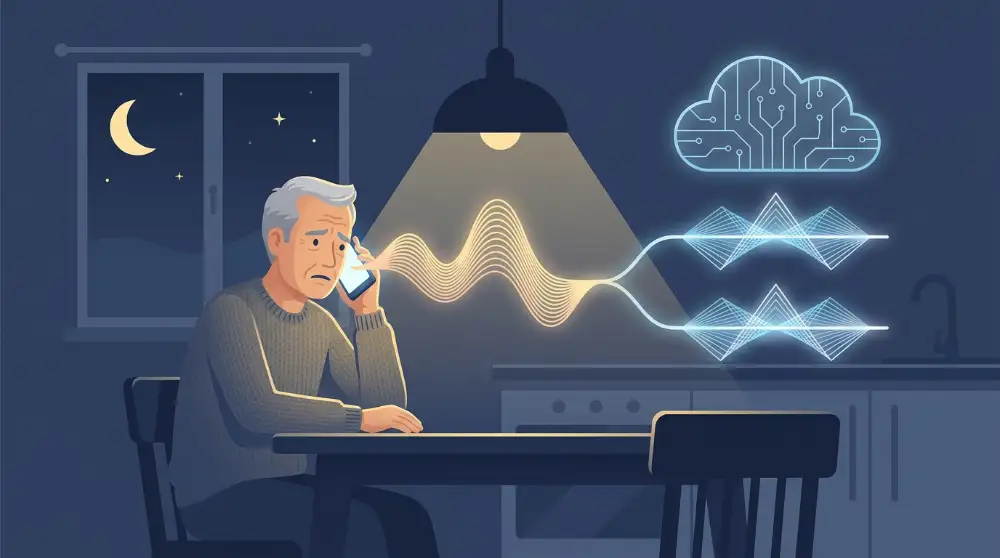
Your phone rings. It's your grandson, or your daughter, and they're crying. There's been a wreck, or an arrest, and they need money right now. The voice is perfect. It might not be them. Here's how AI voice-clone scams work, the warning signs to listen for, and a free five-minute family plan that shuts them down.
What's actually going on
The "grandparent scam" is old news. A crook calls pretending to be a relative in trouble and begs for cash. What's new is the voice. With a short clip of someone talking, like a video they posted online, a cheap voice-cloning program can build a copy that says anything the scammer types. The FTC warned about this back in 2023, and it has only gotten easier since.1
Researchers have shown working clones made from samples only a few seconds long.6 So a birthday video on Facebook, a TikTok, or a voicemail greeting can be all the raw material a scammer needs. The number on your screen can lie, too. Scammers can fake caller ID so the call looks like it's coming from your loved one's own phone.7
This isn't just a big-city problem somewhere else. In June 2026, the FBI warned Houston-area families about fake kidnapping calls that used cloned voices of their relatives.8
How big is it?
For the first time ever, the FBI's yearly internet crime report for 2025 counted scams that involved AI on their own: 22,364 complaints and about $893 million lost.3 People 60 and older filed 3,143 of those complaints and lost roughly $352 million.4
The fake family-emergency calls themselves showed up as just over $5 million in reported losses.4 That sounds small, but there's a catch. The FBI only marked a complaint as AI when the victim said AI was involved, and most people fooled by a perfect copy of a voice never find out it was fake. The real number is almost certainly a lot bigger.4
Zoom out and it gets worse. The FTC says imposter scams of every kind were the most reported fraud in 2025, with more than a million reports and $3.5 billion lost.5
Warning signs on the call
- Panic and a clock. "I need it right now," or a deadline before something terrible happens. Hurry is the scammer's best friend.
- Secrecy. "Please don't tell Mom and Dad." That line exists to stop you from checking.
- A hand-off. Your "relative" passes the phone to a "lawyer," "officer" or "kidnapper" who handles the money talk.
- Strange ways to pay. Gift cards, wire transfers, crypto, a payment app, or a courier coming to your door for cash. Real jails and lawyers don't work like that.19
- Dodging questions. They get upset or vague when you ask something only the real person would know.
The five-minute family plan
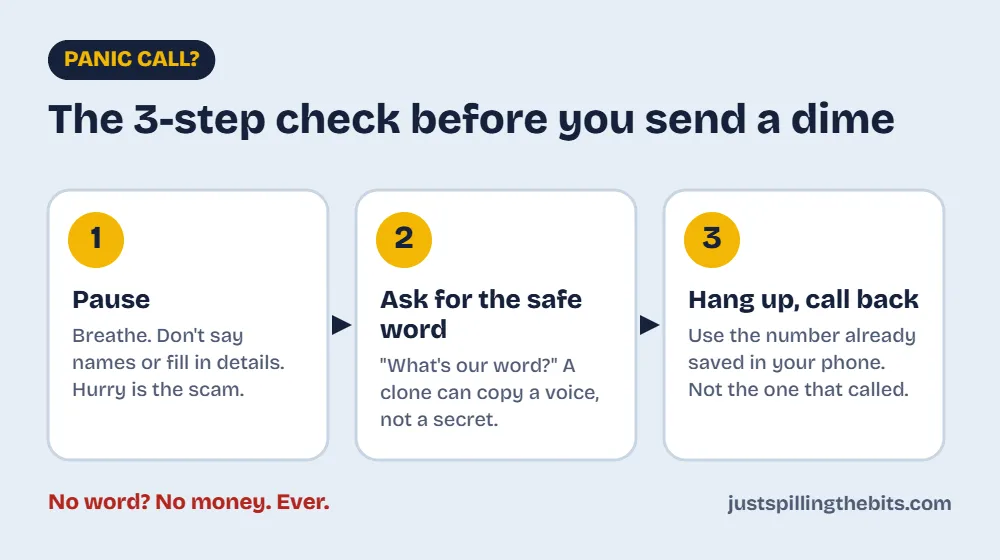
- Pick a family safe word tonight.Choose a word or short phrase that's odd, easy to remember, and has never been posted anywhere online. Skip pet names, birthdays, schools and street names, because scammers can dig those up. "Purple pancake" beats "Buster."
- Share it in person.Tell everyone who might call or get called: parents, grandparents, and kids old enough to have a phone. Don't post it, text it to a group chat, or save it in a note called "safe word."
- When a scary call comes, slow down.Take a breath. Don't fill in names or details ("Jake, is that you?"), because that hands the scammer exactly what they need.
- Ask for the word.Before anything else: "What's our word?" A clone can copy a voice, but it can't know a secret that was never said online. No word, no money.
- Hang up and call back.Call your loved one on the number already saved in your phone, not the number that called you. Can't reach them? Call another family member, even if the caller begged you to keep it quiet.12
- Never pay the "emergency" way.Gift cards, wires, crypto and cash pickups are close to impossible to get back once they're gone.1
- Report it and warn the family.File a report at ReportFraud.ftc.gov and the FBI's ic3.gov, and tell your local police. AARP's free Fraud Watch Network helpline is 877-908-3360, and you don't have to be a member.9 Then give the rest of the family a heads-up. If they tried you, they may try them next.
Copy this and send it to your family
Quick safety thing: scammers can now copy our voices with AI. Let's pick a family safe word. If anyone ever calls in a panic asking for money, ask for the word. If they don't know it, hang up and call that person back on their real number. Let's choose the word together next time we're in the same room.
Extra credit: give scammers less to work with
None of these makes you clone-proof, but each one shrinks the pile of voice clips floating around:
- Switch your voicemail to the phone's plain default greeting instead of recording your own voice.
- Set family videos on social media to friends-only instead of public.
- Let unknown numbers go to voicemail, and don't get pulled into long chats with callers you don't know.
Already sent money?
Move fast. Call your bank, card company or the gift card company right away and tell them it was fraud. When reports come in quickly, the FBI's recovery team can sometimes freeze money before it vanishes; in 2025 it froze about $679 million that criminals tried to move.4 Then file your reports.
And watch for the second punch. "Recovery" crooks call victims pretending to be the FBI or a law firm, promising to get the money back for an upfront fee. Recovery scams took about $1.4 billion in 2025.4 The FBI's rule is simple: anyone claiming to be a federal agent and asking you for money is a scammer.10
The bottom line
I love AI tools. I use them every day to build this site. But this is the flip side: the same tech that can narrate a video can make a crook sound exactly like your grandkid. The good news is that the best defense isn't an app or a gadget. It's an old-school password your family agrees on over dinner. Five minutes tonight could save someone you love thousands of dollars.
Sources
- Federal Trade Commission, "Scammers use AI to enhance their family emergency schemes" (Mar. 20, 2023).
- Federal Trade Commission, "Scammers use fake emergencies to steal your money."
- FBI Internet Crime Complaint Center, "2025 Internet Crime Report" (Apr. 2026).
- PPC Land, "AI-linked fraud costs Americans $893 million, FBI reports for 2025" (July 5, 2026), a breakdown of the IC3 report.
- Federal Trade Commission, "FTC data show people reported losing $3.5 billion to imposter scams in 2025" (June 2026).
- Bruce Schneier, "Voice Cloning with Very Short Samples" (Jan. 15, 2024), on research using one- to twelve-second samples.
- Powell Tribune, "Scammers use AI to clone loved ones' voices," including a McAfee survey of 7,000 people in nine countries.
- Hoodline, "AI fake-kidnap calls rattle Houston families, FBI warns" (June 2026), citing KPRC Click2Houston.
- AARP Pennsylvania, "AARP Pennsylvania warns residents about growing threat of AI scams."
- InvestigateTV via FOX19, "Inside the scam: How criminals impersonate the FBI's complaint center" (Sept. 25, 2026).
Checklist card and share image: original artwork made for this article. Top illustration made with Runway AI. Not legal or financial advice.
More to read
- From MKUltra to AI: the long history of messing with your mind
- Forced to pick, two big AIs split along party lines
- Real race, fake videos: AI ads take over the Texas Senate fight
- The first AI election: $137 million in AI-made ads, and the AI money behind the races
- How to spot an AI political ad before you vote (or share it)
- What Trump is actually doing about AI, and what Americans think of it