Cyborg brains: how close are brain implants, really, and what does AI have to do with it?
Oct. 22, 2026 · The Science Bits
Chips in people's brains used to be pure science fiction. Now well over a hundred people are living with them, typing with their thoughts and even talking again. Here's what's actually working, where AI fits in, what could go wrong, and how far we really are from "cyborgs."
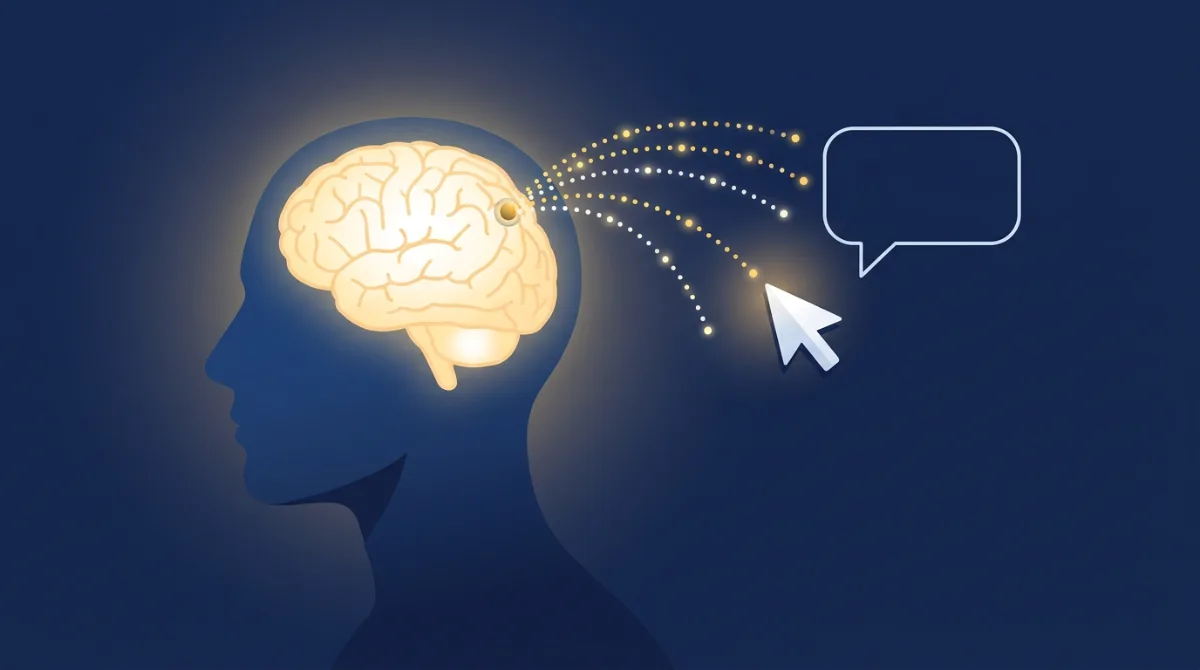
First, what is a brain implant?
The official name is a brain-computer interface, or BCI. The idea is simple to say and hard to do: put tiny sensors where they can pick up the electrical chatter of your brain cells, then use software to turn that chatter into something useful, like moving a computer cursor or speaking a sentence.
Right now, almost all of this is aimed at people who've lost the ability to move or speak, from things like ALS, spinal cord injuries and strokes. Nobody is selling a brain chip to make healthy people smarter. Not yet, anyway.
There are three ways in
Every company is trying to solve the same trade-off: the closer you get to the brain cells, the clearer the signal, but the bigger the surgery.
- Through a veinSynchron threads its device up through the jugular vein in the neck and parks it inside a blood vessel next to the brain's movement area. No opening the skull.4
- On the surfacePrecision Neuroscience slides a thin, flexible film onto the brain's surface through a tiny slit. Its version is cleared by the FDA for up to 30 days, mainly for mapping the brain during surgery.7
- Into the brainNeuralink and Paradromics put hair-thin electrodes directly into brain tissue. That gives the sharpest signal, but it means real brain surgery.25
The scoreboard: where things stand right now
- Neuralink: Elon Musk's company said in January that 21 people worldwide were enrolled in its trials, two years after its first human implant. Its first patient uses it to browse the web, play video games and post online.1 In May, surgeons in Toronto did its first "transdural" implant, sliding the threads through the brain's tough outer covering instead of cutting it away. The patient was moving a cursor within an hour.2
- Synchron: The vein-route company says 100 people have now been implanted across the U.S., Australia and the U.K., and it plans to ask the FDA for a final, larger "pivotal" trial before the end of 2026.4 It has also worked with Apple so its users can control an iPhone, iPad or Apple Vision Pro with their thoughts.15
- Paradromics: The FDA approved its clinical trial in November 2025. In June, doctors at the University of Michigan implanted the first patient, a woman who has trouble speaking because of motor neuron disease.5 By September, the company said she was producing speech in real time.6
- China: Chinese state media reported in April that regulators approved a hand-function implant called NEO, from Neuracle and Tsinghua University. People with paralysis use it to open and close a powered glove with their thoughts. China calls it the world's first regulatory approval of an implantable BCI for medical use.8
Bottom line: in the U.S., none of these brain-reading implants is FDA-approved as a long-term medical product yet. They're all still in trials.
Where AI comes in: it's the translator
An implant by itself just records a storm of electrical spikes. AI is what figures out what that storm means. That's why brain implants have jumped forward so fast in the last few years: the AI got good.
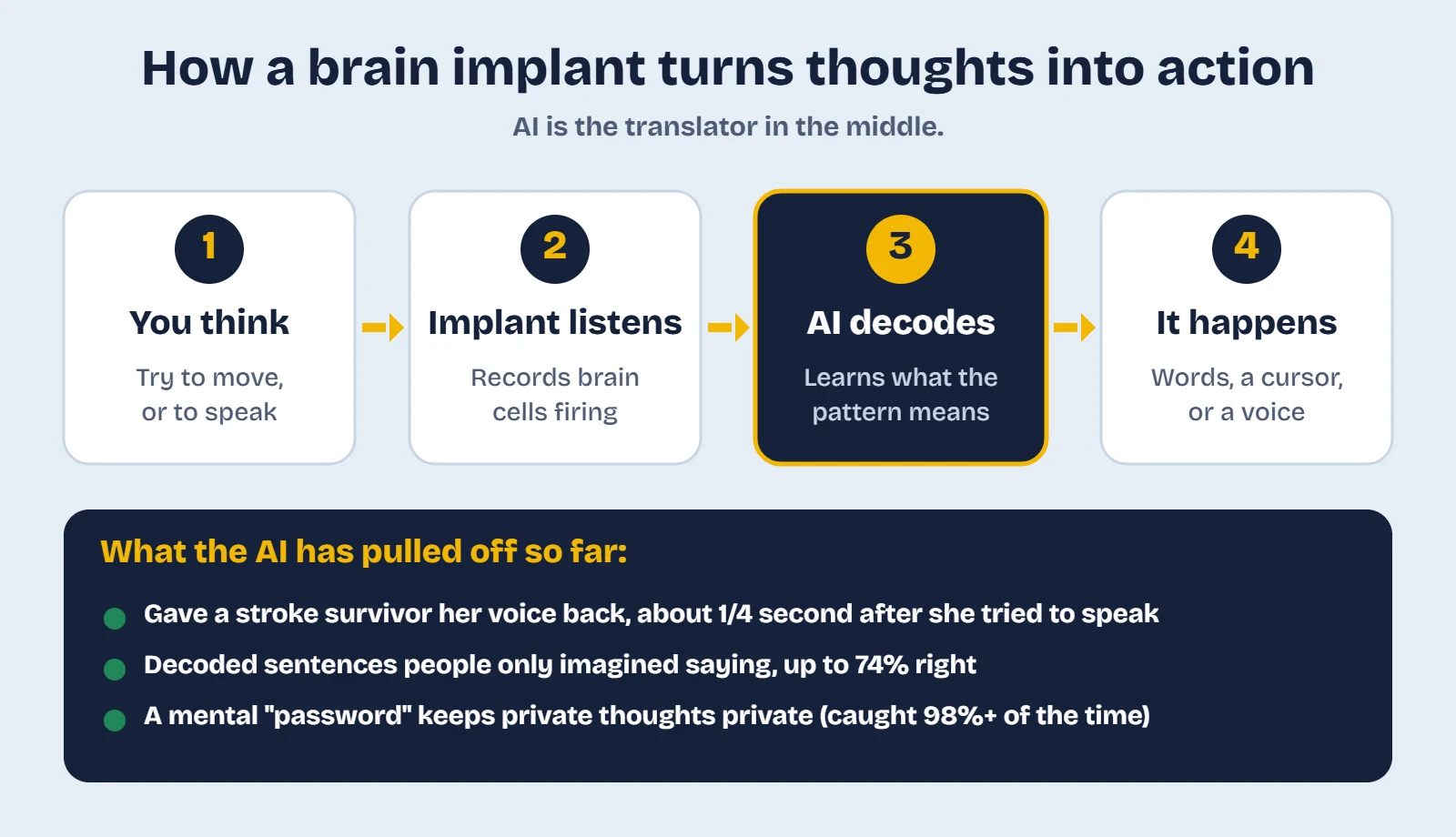
What AI has already pulled off
- A voice back in near real time. Researchers at UC San Francisco and UC Berkeley fed a deep learning system over 23,000 of a woman's silent tries at talking. She hadn't been able to speak for 18 years after a stroke. It turned her brain signals into audible speech about a quarter second after she tried to say each word.9
- Reading "inner speech." A Stanford team decoded sentences that four people only imagined saying. Working with a word list as big as 125,000 words, it got up to 74% of them right. They also built a mental "password": the decoder stays off until the person thinks a chosen phrase, and it caught that phrase more than 98% of the time.10
- Brain "foundation models." Synchron is working with Nvidia on an AI model called Chiral, trained on brain-signal data, the same basic idea as the large language models behind chatbots, but for the brain.16
The ups
Why people are excited
- Giving people their voice back. For someone locked in by ALS or a stroke, going from blinking at a letter board to talking is life-changing.
- Independence. Texting, browsing, controlling a phone or smart home without help from a caregiver.
- Gentler options. Approaches like going through a vein or a slit in the skull mean not every implant needs a big opening in the head.47
- Sight is next on the list. Neuralink's "Blindsight" project, meant to send images straight to the brain's vision area for people who are fully blind, got the FDA's breakthrough device tag in 2024.17
The downs and the dangers
What could go wrong
- It's still brain surgery. Any operation on the brain carries real risks, like infection and bleeding. That's a big reason these are only being tested on people with serious medical needs.
- Hardware can slip. In 2024, Neuralink said a number of the threads in its first patient's implant pulled back out of his brain in the weeks after surgery, which hurt his cursor control until the company patched it with software changes.3
- What if the company goes away? This has already happened. More than 350 blind people had bionic eye implants from a company called Second Sight. When the company ran into money trouble in 2020, it stopped supporting them, leaving some patients with devices nobody could fix.11
- Your brain data. Brain signals can reveal health problems, moods and more. A survey by the Neurorights Foundation found 29 of 30 companies selling brain-reading gadgets online could access users' brain data with no meaningful limits.12 Only four states, California, Colorado, Montana and Connecticut, treat brain data as sensitive by law, and a federal bill called the MIND Act hasn't gotten out of committee.13
- The "mind reading" question. The fact that researchers had to build a mental password into the Stanford system tells you how real the privacy issue is getting.10
So, where is this heading?
The next few years: bigger trials, starting with Synchron's planned pivotal trial, and possibly the first FDA approvals for people with severe paralysis.4
The money: Morgan Stanley has pegged the potential U.S. market at around $400 billion, but its own forecast calls for slow uptake, reaching less than 3% of possible patients by 2045.14 Big potential, slow road.
The 2030s: speech and movement implants could become a real treatment option, and early vision implants could start testing on people. Expect blurry, basic vision at first, not movie-quality sight.
"Cyborg" upgrades for healthy people: that's still science fiction. Nobody is close to safely wiring a healthy brain to the internet, and the surgery risks alone make it a hard sell.
What we can learn from it
- The real story is medical, not sci-fi. The breakthroughs are about helping people who can't move or speak, and that's exciting enough on its own.
- AI is the engine. Better decoders, not just better chips, are what made the recent leaps possible.
- Ask who supports the device in 10 years. Second Sight showed that a brain implant is only as good as the company behind it.
- Brain data needs rules now, before consumer gadgets and AI make it easy to collect and hard to protect.
My take: As a PC guy, I keep thinking of this like a new piece of hardware with a killer driver. The hardware, tiny threads and films and stents, is impressive. But AI is the driver that makes it actually work, and that's the part moving fastest. Watching people who couldn't talk start talking again is the best use of AI I've seen yet. Still, I'd want three answers before anyone I love got one: who fixes it in ten years, who owns the data, and what happens if the company folds. Cyborgs? Not anytime soon. Medical miracles for people who really need them? Those are already here.
How this was made: I used AI (Claude, by Anthropic) to help research and draft this piece. Every fact was then checked against the original source listed below, and everything is written in our own words. Numbers and quotes belong to the people and outlets credited. This is a look at the science and the news, not medical advice.
References & credits
- Reuters via Yahoo News, "Elon Musk's Neuralink says it has 21 participants enrolled in trials" (Jan. 2026).
- Road to VR, "Elon Musk's brain-chip startup aims for scalability with new transdural procedure" (July 1, 2026).
- The Register, "Neuralink trial update" (May 9, 2024).
- NeuroTech.com, "Synchron reaches 100-patient milestone as Stentrode BCI moves toward pivotal trial" (June 9, 2026).
- Business Wire (Paradromics), "Paradromics and University of Michigan complete first Connexus BCI implantation" (June 17, 2026).
- RuntimeWire, "Paradromics' first BCI user generates real-time speech" (Sept. 23, 2026).
- Fierce Biotech, "FDA clears Precision Neuroscience's minimally invasive brain-computer interface implant" (Apr. 17, 2025).
- People's Daily Online, "China approves world's first implantable brain-computer interface for medical use" (Apr. 21, 2026).
- National Institutes of Health, "Brain-computer interface restores natural speech after paralysis," on a study in Nature Neuroscience (Apr. 29, 2025).
- Gizmodo, "New brain interface interprets inner monologues with startling accuracy," on a Stanford study in Cell (Aug. 14, 2025); also Scientific American.
- IEEE Spectrum, "Their bionic eyes are now obsolete and unsupported" (2022).
- KFF Health News, "States pass privacy laws to protect brain data collected by devices" (July 23, 2025).
- Inside BCI, "US states build patchwork of neural data privacy laws" (Apr. 3, 2026).
- Neurotechnology (Substack), "$400 billion BCI," summarizing a Morgan Stanley report (2024).
- Business Wire (Synchron), "Synchron to achieve first native brain-computer interface integration with iPhone, iPad and Apple Vision Pro" (May 13, 2025).
- Medical Device Developments, "Synchron unveils roadmap to cognitive AI with Chiral brain model" (Mar. 20, 2025).
- Wikipedia, "Blindsight (Neuralink)," citing Reuters (Sept. 17, 2024).
Images: hero illustration made with Runway AI; diagram made by Just Spilling the Bits. No outside images used.
More to read
- From MKUltra to AI: the long history of messing with your mind
- Forced to pick, two big AIs split along party lines
- Real race, fake videos: AI ads take over the Texas Senate fight
- The first AI election: $137 million in AI-made ads, and the AI money behind the races
- How to spot an AI political ad before you vote (or share it)
- What Trump is actually doing about AI, and what Americans think of it